We ran a job off Dunns Road last winter where the contractor hit grey, saturated silts at barely four metres. The face kept squeezing into the pilot tunnel, and without a proper geotechnical analysis for soft soil tunnels, the whole drive would have collapsed. Invercargill sits on deep Quaternary alluvium — the Oreti and Makarewa river deposits — and that means fine-grained, normally consolidated material that creeps under even modest overburden. Our lab stepped in with a full triaxial suite and consolidation testing to constrain the undrained shear strength profile, feeding into the deep excavation design that kept the launch shaft stable. When you are pushing a TBM or doing sequential excavation through the city’s underlying silty clays, the difference between a controlled face and a blowout comes down to how well you characterize the ground beforehand.
In normally consolidated Invercargill silts, Su/σ’v ratios below 0.25 demand face support pressures that generic parameters simply cannot predict.
Methodology applied in Invercargill
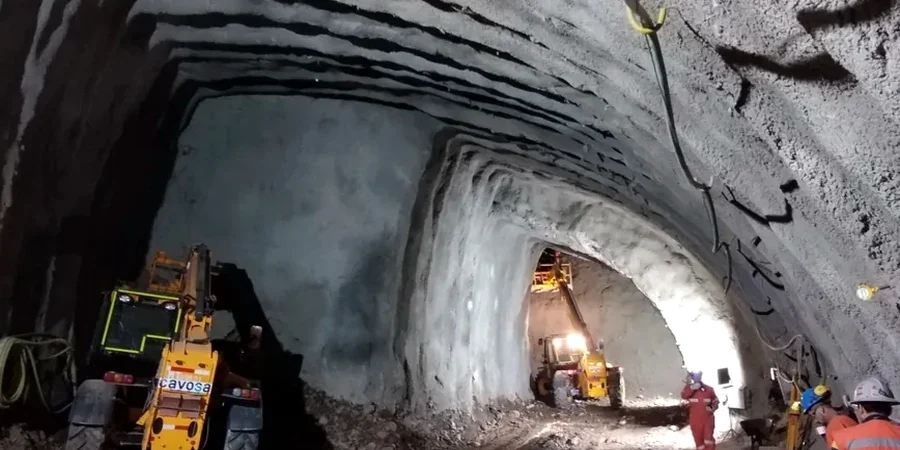
Local geotechnical conditions in Invercargill
The Invercargill Formation beneath the CBD is a thick sequence of interbedded silts, peats, and occasional sand lenses, with groundwater typically within two metres of surface during winter. Face instability in soft-ground tunnelling here is driven less by lack of strength and more by the time-dependent response: the undrained creep rate under constant deviatoric stress can be alarmingly fast. We have seen pore pressure equilibration take weeks in low-permeability silts, meaning the short-term condition is undrained and the long-term condition is drained — two completely different failure mechanisms. If you design only for the short-term Su and ignore consolidation-induced softening around the excavation, you get progressive face slabbing. Combine that with the seismic demand under NZS 1170.5 and the risk shifts from routine to severe. Foundation interaction with adjacent structures on shallow footings — half of Dee Street’s heritage buildings — makes settlement prediction from our oedometer data a non-negotiable part of the assessment.
Our services
Our soft-ground tunnel investigation package draws together field characterization and high-level lab testing specifically configured for Invercargill’s alluvial sequence. Every test program is tailored to the tunnelling method — TBM, roadheader, or sequential excavation — and the required design parameters.
Advanced Triaxial and Consolidation Testing
K0-CU and CIU triaxial suites with pore pressure measurement, plus incremental oedometer testing to define the full compressibility and strength envelope for tunnel face stability analysis and lining design.
Soil Classification and Index Property Suite
Atterberg limits, hydrometer particle size distribution, natural moisture content, and bulk density determination per NZS 4402, establishing the baseline for assessing squeezing potential and filter compatibility.
Time-Dependent Behaviour and Permeability Profiling
Constant-head permeability testing and secondary compression measurement from oedometer data, combined with field CPTu dissipation correlations, to predict consolidation settlement and pore pressure response around the excavation.
Quick answers
How much does a geotechnical analysis for soft soil tunnels in Invercargill typically cost?
For a soft-ground tunnel investigation in Invercargill, the lab testing component typically ranges from NZ$6,060 to NZ$27,240, depending on the number of boreholes, sample depth intervals, and the complexity of the triaxial and consolidation program required. A basic suite covering classification and a few strength tests sits at the lower end; a full effective-stress path triaxial program with incremental oedometers for a multi-kilometre alignment will be at the upper end. Field investigation costs are additional and depend on access, traffic management, and drilling depth.
Which lab tests are critical for TBM tunnel design through Invercargill silts?
For EPB or slurry TBM design, you need K0-consolidated undrained triaxial tests to establish the undrained shear strength profile and stiffness degradation, incremental oedometer tests to define compressibility and consolidation coefficient cv, and Atterberg limits with hydrometer grain size for assessing clogging potential at the cutterhead. Permeability testing — both lab flexible-wall and field CPT dissipation — is essential to design face support pressure and conditioning agent dosage.
How do you account for seismic effects on soft-ground tunnels in Invercargill?
We characterise the soil’s cyclic behaviour through the effective stress parameters from CIU triaxial testing and assess liquefaction susceptibility of any sand lenses within the alluvium using grain size and fines content data. The undrained shear strength ratio from K0-CU testing feeds into numerical models for ovaling and racking deformation under the NZS 1170.5 design earthquake, while the oedometer-derived compression index predicts post-seismic consolidation settlement.
What is the typical turnaround time for a soft-ground tunnel testing programme?
A standard soft-ground tunnel investigation programme — classification tests plus a set of triaxial and oedometer tests on 15 to 25 samples — typically takes four to six weeks from sample receipt to draft report. Consolidation tests run the longest because we wait for primary consolidation to complete naturally; accelerated schedules are possible with staged loading, but we prefer standard 24-hour increments for defensible cv values. Rush testing can be arranged for critical path items.