Invercargill sits on deep alluvial gravels and silts from the Oreti River floodplain, with groundwater tables often within 2 metres of the surface. When a project requires more than just index properties—retaining walls along the Waihopai embankment, deep excavations in the CBD, or foundation design for industrial sheds near the airport—the triaxial test becomes the only way to capture how the soil behaves under the confining pressures it will actually experience. Our lab runs consolidated-undrained and consolidated-drained triaxial setups on undisturbed Shelby tube samples, measuring effective cohesion and friction angle at cell pressures up to 1,000 kPa. The equipment is calibrated under ISO 17025 procedures and the results feed directly into limit-equilibrium slope models and finite-element analyses. For roading projects on waterlogged subgrades, we often pair the triaxial test with a CPT log to validate the undrained shear strength profile and confirm whether pore-pressure dissipation is realistic before construction.
Effective stress parameters from a triaxial test can halve the factor of safety uncertainty compared with total-stress correlations alone.
Methodology applied in Invercargill
- Determination of initial dry density and moisture content on the trimmings
- Saturation ramp with continuous volume-change monitoring
- Post-shear water content to verify full saturation was maintained
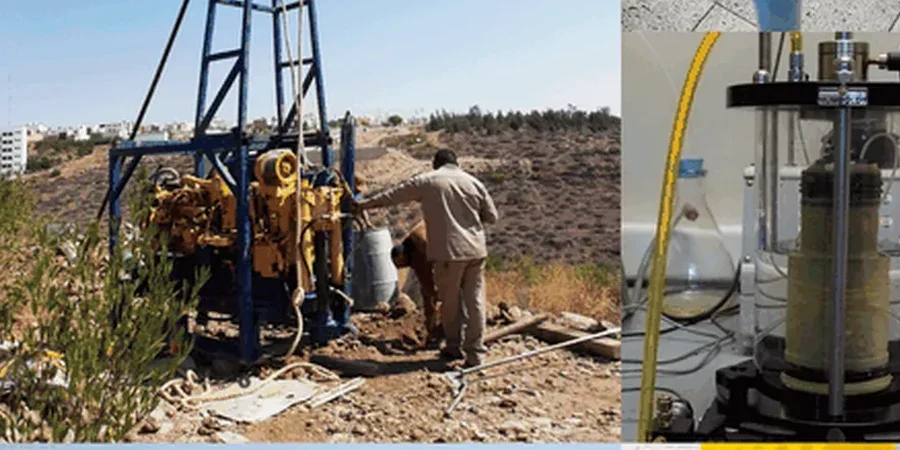
Procedure video
Local geotechnical conditions in Invercargill
The contrast between the well-drained gravel terraces of Gladstone and the compressible estuarine silts near the New River estuary shows why a single undrained triaxial value cannot be blanket-applied across Invercargill. In the northern suburbs, dense gravels can generate negative pore pressures during shear, inflating the apparent friction angle if not properly saturated; in the south, soft normally consolidated silts show contractive behaviour and a sharp drop in deviator stress once the critical state is exceeded. Basing a retaining wall design on a drained friction angle without confirming the drainage condition can lead to an overestimated factor of safety—especially where the water table rises seasonally. The triaxial test isolates that difference by controlling drainage and measuring pore pressure directly, giving the design team a clear view of whether the soil will drain during the structure’s design life or remain undrained and strength-limited.
Our services
Our Invercargill laboratory supports the triaxial program with two complementary services that reduce the number of mobilisations and speed up the design timeline.
Undisturbed Sampling with Shelby Tubes
Thin-walled tube sampling from boreholes or test pits across the Invercargill basin. Samples are sealed with wax immediately on site, transported in foam-lined crates, and extruded in the lab within 24 hours to minimise moisture loss before the triaxial test.
Consolidation and Permeability Triaxial Stage
Before shearing, we run an isotropic consolidation stage with back-pressure saturation and measure the coefficient of permeability directly on the triaxial specimen. This data feeds the consolidation-rate calculations for staged embankment construction on the compressible silts of the Southland plain.
Quick answers
What is the typical cost of a triaxial test program in Invercargill?
A three-specimen consolidated-undrained triaxial program on undisturbed samples typically ranges from NZ$3,400 to NZ$5,150, depending on the cell pressure range, saturation time required for silty material, and whether cyclic triaxial stages are added for liquefaction assessment. The fee includes sample extrusion, specimen preparation, saturation, shearing, and a full interpretive report with Mohr-Coulomb parameters and stress-strain curves.
How many specimens are needed for a complete triaxial test?
A minimum of three specimens is standard to define the Mohr-Coulomb failure envelope at different cell pressures. If the material is fissured or variable, a fourth specimen may be advisable. For cyclic triaxial liquefaction assessment, the MBIE/NZGS Module 4 protocol usually requires three to five specimens tested at different cyclic stress ratios.
Can you run triaxial tests on gravels from the Oreti River terraces?
Yes, but the maximum particle size must be smaller than one-sixth of the specimen diameter. For the standard 50 mm specimen, that limits us to gravel particles under 8 mm. For coarser material, we use a 70 mm diameter specimen or remould the sample to a controlled density after scalping the oversize fraction.
How long does the triaxial test take from sample collection to report?
If undisturbed samples arrive in good condition, a standard consolidated-undrained triaxial program takes five to seven working days. Silty samples that require extended back-pressure saturation can add one or two days. Cyclic triaxial programs typically require eight to ten working days because of the staged loading sequence.