Driving a split spoon sampler near Queens Park is a different beast than working the silty flats out by the New River Estuary. The upper terrace gravels give you a sharp ring count fast, while the softer alluvium near the Oreti can swallow up a third of your drive before you even record a blow. That's the reality of SPT testing in Invercargill, and it's why we run every test with an eye on the local geology. We follow NZS 3404 procedures to the letter, recording penetration resistance at every 150 millimetres. When clients need a clearer picture of the fines content in those estuarine silts, we'll often recommend pairing the SPT with a grain size analysis to confirm the gradation curve before finalising bearing capacity numbers. Invercargill's groundwater sits high across much of the city, so borehole conditions matter as much as the hammer energy.
In Invercargill, knowing whether your N-value came from a dense Mataura gravel or a cemented glacial till changes your foundation design entirely.
Methodology applied in Invercargill
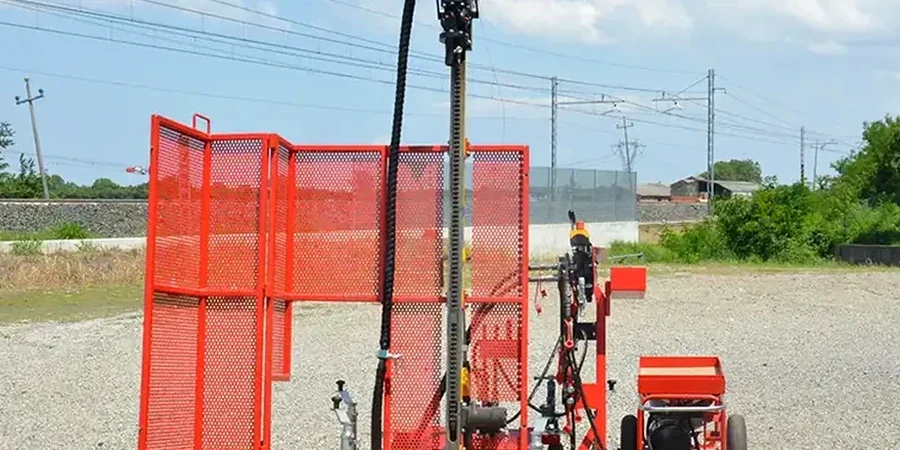
Procedure video
Local geotechnical conditions in Invercargill
Invercargill sits at roughly 56,000 people, with a building stock that's felt its share of shaking. The 2009 Fiordland quake (Mw 7.8) rattled the city enough to remind everyone we're in a seismic zone. Liquefaction susceptibility in the loose, saturated silts underlying parts of the southern suburbs isn't theoretical; it's mapped in the regional council's hazard studies. An SPT that stops at 10 metres when the liquefiable layer extends to 15 is a liability. We push boreholes deep enough to catch the critical zone, and we know that the N-value thresholds for triggering liquefaction in Southland's soils need careful interpretation against the NZGS guidelines. The biggest risk we see is clients trying to save a few metres of drilling depth and ending up with a foundation that doesn't account for the loose layer sitting just below their investigation limit.
Our services
Our Invercargill SPT testing fits into a wider geotechnical workflow. These are the services we run alongside the standard penetration test to give you a complete ground model.
SPT Drilling & Logging
Full SPT borehole programme with split spoon sampling, field logging of soil type, moisture, and consistency, and N-value reporting per NZGS conventions.
Liquefaction Assessment
Interpretation of SPT blow counts for liquefaction triggering analysis, following Boulanger & Idriss methodology adapted for NZ conditions.
Foundation Design Parameters
Translation of SPT N-values into bearing capacity and settlement estimates for shallow footings and pile design in Invercargill's varied soil profile.
Quick answers
What does SPT testing cost in Invercargill?
For a typical SPT borehole in the Invercargill area, you're looking at NZ$880 to NZ$1,440 per hole depending on depth, access, and whether we're dealing with casing through peat or soft ground. A full site investigation with multiple holes and reporting will scale from there. We quote per job, not per metre, because every site's ground conditions are different.
How deep do you run SPT tests in Invercargill?
We run SPTs at 1.5 metre intervals from the surface, typically down to refusal or the planned investigation depth. For residential work, 6 to 10 metres is common. For commercial sites with deeper loads or liquefaction concerns, we'll push to 15 or 20 metres if the ground allows it. The depth stops when we hit dense gravels that give N-values over 50 for three consecutive drives.
Do you correct N-values for overburden pressure?
Yes, we provide N60 corrections as standard when requested. The raw field N-value goes into the log, and we apply corrections for hammer energy, rod length, borehole diameter, and overburden pressure following the NZGS guidelines. For liquefaction work, the corrected N1(60) is what matters, and we calculate that as part of the assessment.
How many SPT boreholes does my Invercargill site need?
NZGS Module 1 guidelines suggest a minimum of three boreholes for a typical residential subdivision lot, spaced to capture lateral variability. For a single dwelling on a flat site with known geology, two might suffice. We'll advise based on the site's position within Invercargill's geological map and the complexity of the proposed structure.