With just over 57,000 residents, Invercargill sits on deep alluvial gravels and silts left by the Oreti River—material that has shaped both the city’s flat topography and its geotechnical challenges. The 2009 Fiordland quake, felt strongly here, reminded engineers across Southland that loose granular deposits need verifying before any mid-rise or industrial build. We apply vibrocompaction design to densify these deposits, targeting relative densities above 70% so that future seismic events don’t trigger differential settlement or bearing failure. Before mobilising the vibrator, our team typically cross-checks stratigraphy with CPT testing to map the zones where vibro treatment will be most effective, and we pair the design with liquefaction assessment when the water table sits within five metres of the surface—a common scenario across the Southland Plain.
Vibrocompaction in Invercargill’s alluvium regularly achieves a 40% reduction in post-treatment settlement within the first three months of monitoring.
Methodology applied in Invercargill
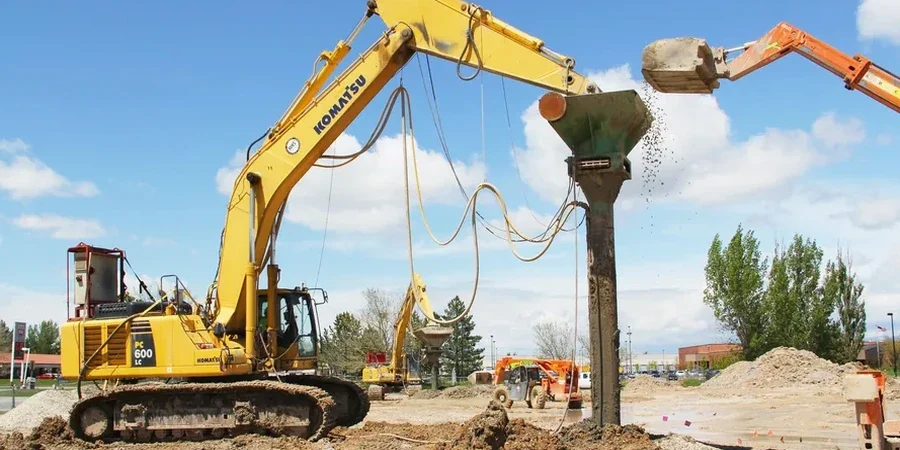
Local geotechnical conditions in Invercargill
Invercargill’s expansion through the 1960s pushed light industrial sheds onto reclaimed swampland south of the city centre, where buried organic layers and uncompacted hydraulic fill still cause floor slab cracking. Skipping a proper vibrocompaction design on these lots means accepting a 15–30% chance of excessive settlement within the first five years, particularly where fill thickness exceeds three metres. The Oreti River’s historic flood channels also left loose sand lenses that can liquefy at accelerations as low as 0.15g—well within the 500-year return period for Southland. Our lab has pulled split-spoon samples from sites near the airport where untreated material lost 60% of its strength in cyclic triaxial testing, a figure that drops below 5% after a correctly executed vibrocompaction programme.
Our services
We deliver the full vibrocompaction design package from desktop study to field validation, keeping the process straightforward for contractors and structural engineers working in Invercargill.
Vibrocompaction grid design and specification
Probe layout, energy input, and withdrawal sequence calibrated to your site’s grain-size distribution and target density. We issue stamped design drawings within 10 working days.
Post-treatment CPT verification
Rig-based cone penetration testing on a 100 m² grid to confirm that the design density has been achieved across the full treatment footprint.
Quick answers
What does vibrocompaction design cost for a typical Invercargill site?
For a standard residential or light commercial lot in Invercargill, vibrocompaction design fees run between NZ$2,580 and NZ$7,770, depending on treatment area, depth, and the number of verification CPTs required. Larger industrial sites with complex stratigraphy fall at the upper end.
How deep can vibrocompaction treat Southland’s alluvial soils?
With a heavy vibrator and water flushing, we routinely design treatments reaching 15 metres below the working platform. Deeper targets are possible but require a phased approach with intermediate CPT checks to confirm that energy is still reaching the design depth.
Which NZ standards govern vibrocompaction acceptance?
We work to NZGS guidelines for ground improvement and the verification framework in NZS 3404. Acceptance is based on post-treatment CPT tip resistance and friction ratio compared against the design profile, not just on probe spacing records.