The soil contrast between Invercargill's CBD near the Oreti River and the Windsor area to the north dictates two very different foundation strategies. Downtown, the shallow water table and compressible alluvial silts make isolated footings a gamble; a stiffened raft slab bridges soft zones and controls differential settlement. Out in Windsor, where older gravel terraces appear, the risk shifts to liquefaction-prone layers at depth. Designing a mat foundation here means running the full NZGS Module 4 assessment before selecting the ground improvement method. Our lab starts every project with a continuous CPT profile to map the transition between the superficial crust and the underlying loose sands, and the seismic refraction survey gives us the shear-wave velocity needed for site class determination under NZS 1170.5.
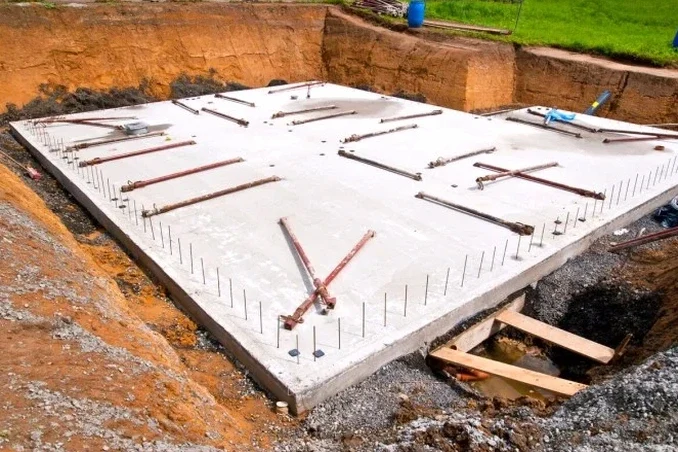
A properly designed raft turns Invercargill's worst ground—deep compressible silt with groundwater at 0.8 m—into a stable, predictable foundation system.
Methodology applied in Invercargill
Procedure video
Local geotechnical conditions in Invercargill
Invercargill's expansion southward during the 1960s and 70s pushed residential subdivisions onto reclaimed swamp margins that had never supported structural loads. The geotechnical legacy is a patchwork of filled ground, buried organic layers, and variable peat lenses—all of which produce uneven settlement under concentrated footing loads. A raft foundation mitigates this by spreading the building weight across the entire footprint, but the design is only as good as the ground model underneath it. If the investigation misses a thin peat pocket at 2.5 m depth, long-term creep settlement can tilt the slab beyond serviceability limits. We address this by running staged plate load tests at formation level and cross-checking the stiffness modulus against the CPT tip resistance; when the two datasets diverge by more than 15 percent, we extend the investigation depth before finalizing the mat reinforcement.
Our services
Our Invercargill raft design workflow covers the full chain from subsurface investigation to reinforcement detailing, always referenced to the local ground conditions south of the Mataura fault zone:
Subsurface investigation for rafts
CPT and machine-dug test pits to define the crust thickness, groundwater level, and liquefaction potential before mat design begins.
Settlement and bearing capacity analysis
Finite-element settlement predictions under NZS 3404 serviceability criteria, with sensitivity runs for variable silt compressibility.
Ground improvement integration
Design of stone column grids or vibrocompaction patterns beneath the raft to meet differential deflection limits on Class D soils.
Construction-phase QA and slab testing
On-site concrete sampling, slump and temperature monitoring, and 28-day cylinder breaks to confirm design strength for the mat pour.
Quick answers
When does an Invercargill site need a raft instead of standard footings?
When the near-surface soil has an undrained shear strength below 30 kPa, the groundwater table sits within 1.5 m of the surface, or the predicted differential settlement exceeds 15 mm between columns. On the deep silt profiles common along the Oreti floodplain, a raft usually becomes the economic choice once the building exceeds two storeys.
What is the typical cost range for a raft foundation design package in Invercargill?
The design package—covering CPT investigation, lab testing, settlement analysis, and the final reinforcement drawings—ranges from NZ$1,680 for a straightforward single-storey slab on competent gravel to NZ$6,950 for a multi-level raft on stone-column-improved silt with full seismic assessment.
How do you handle the high groundwater during raft construction?
We specify a well-compacted drainage blanket and, where necessary, temporary dewatering spears around the excavation perimeter. The concrete mix is adjusted for sulfate exposure if groundwater testing shows elevated sulfates, a common condition in Invercargill's estuarine-derived sediments.
Do you carry out the concrete testing on site or in a third-party lab?
Our own lab in Southland is accredited to ISO 17025. We cast cylinders on site during the pour, cure them under standard conditions, and report compressive strength at 7 and 28 days—so the design engineer has verified data before the superstructure framing starts.