Invercargill sits just 11 metres above sea level on the Southland Plains, a city where groundwater is never far from the surface. With a population hovering around 57,000 and some of New Zealand’s most expansive peat and alluvial silts right underfoot, road designers here have a genuine challenge. The laboratory CBR test becomes essential for anyone building pavements, car parks, or subdivisional roads across these soft grounds. Our team runs soaked CBR tests at standard Proctor compaction levels, giving you a clear picture of how the local subgrade will behave once it’s saturated. We feed that data straight into your pavement thickness design, because guessing is expensive when the water table is less than a metre down in parts of Otatara. When the soil profile shows highly variable layers, we often recommend pairing CBR data with a test pit investigation so you can visually confirm the stratum before committing to a structural section.
A soaked CBR test tells you what the subgrade will do after a Southland winter – the unsoaked value is just the preview.
Methodology applied in Invercargill
Procedure video
Local geotechnical conditions in Invercargill
The difference between South City and the newer subdivisions out by Otatara is night and day when it comes to subgrade risk. South City sits on reasonably well-drained gravels, and you can typically achieve a CBR of 5% or better without treatment. Otatara, on the other hand, floats on deep peat and soft silts where CBR values under 1.5% are common. If you apply a pavement design calibrated for South City conditions to an Otatara site without running site-specific laboratory CBR tests, the pavement will rut within two seasons. The cost of a lab test is measured in hundreds; the cost of a premature pavement failure is measured in tens of thousands. We see this mismatch regularly when contractors import a design from one side of town to the other. Different ground, different number. Run the test, get the right value, and size your basecourse accordingly.
Our services
Our Invercargill lab handles the full workflow from sample receipt to interpretive report. We don’t just run a machine and hand you a number; we connect the test result to your specific pavement design and site conditions.
Soaked CBR (Standard Laboratory)
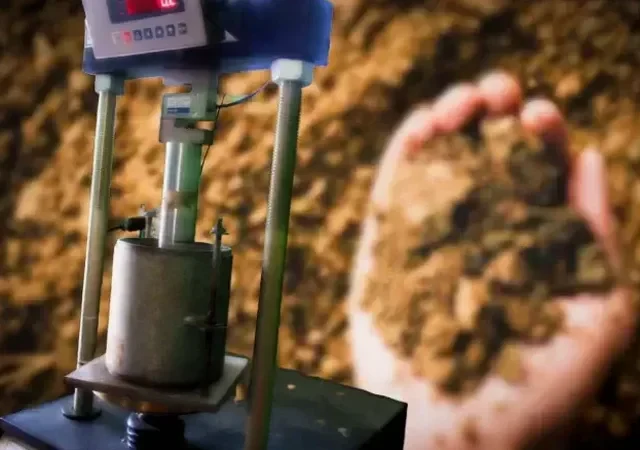
The core test for pavement subgrade evaluation. Remoulded sample compacted at optimum moisture content, soaked for 4 days, and penetrated at a controlled rate. You get CBR at 2.5 mm, CBR at 5.0 mm, dry density, and moisture content on a signed report.
CBR with Supplementary Testing
When the material is borderline, we combine the laboratory CBR test with Atterberg limits or a particle size distribution. This helps identify if the problem is excess plasticity or poor grading, so your remediation is targeted rather than trial-and-error.
Quick answers
How much does a laboratory CBR test cost in Invercargill?
For a standard soaked CBR test on a single remoulded sample, you’re looking at NZ$190 to NZ$340 depending on the compaction effort and whether supplementary tests like moisture content or grading are bundled. We quote per sample, so you only pay for what your site actually needs.
What is the difference between a field CBR and a laboratory CBR?
A field CBR test measures the subgrade in situ without removing the soil, which is useful for QA during construction. The laboratory CBR test is run on a remoulded sample compacted at a controlled moisture content and soaked to simulate worst-case conditions. The lab test is what pavement designers use to set the structural thickness before construction starts.
How long does it take to get results from the lab?
The soaking phase alone is four days. Sample preparation, compaction, the penetration run, and reporting add another day or two. Realistically, you should allow five to seven working days from when we receive the bagged sample to when the signed report hits your inbox.
Do you accept bag samples from contractors?
Yes, we run CBR tests on bulk samples delivered by contractors, provided the material is properly sealed in heavy-duty plastic bags to preserve the natural moisture content. If the sample arrives dried out or contaminated, we’ll flag it before proceeding because the result won’t be representative of the site.