Invercargill's flat topography masks what lies beneath: deep saturated alluvium from the Oreti and Makarewa rivers, with groundwater often less than a metre down. Soft silts and peats extend beyond 10 metres in pockets across the city. Standard footings fail here. You need a ground improvement strategy that works with the soil, not against it. Stone column design transfers load through these weak layers to more competent strata by creating stiff, draining inclusions. The gravel columns compact the surrounding ground radially and provide a drainage path that accelerates consolidation settlement before the structure goes up. Our lab supports this from the start. Before we specify column diameter, spacing, and depth, we run grain size analysis to confirm the native soil fines content, and tactile CPT soundings to map the exact depth of compressible layers under the footprint.
A well-designed stone column grid in Invercargill's alluvium can double the bearing capacity of the untreated soil while cutting post-construction settlement by half.
Methodology applied in Invercargill
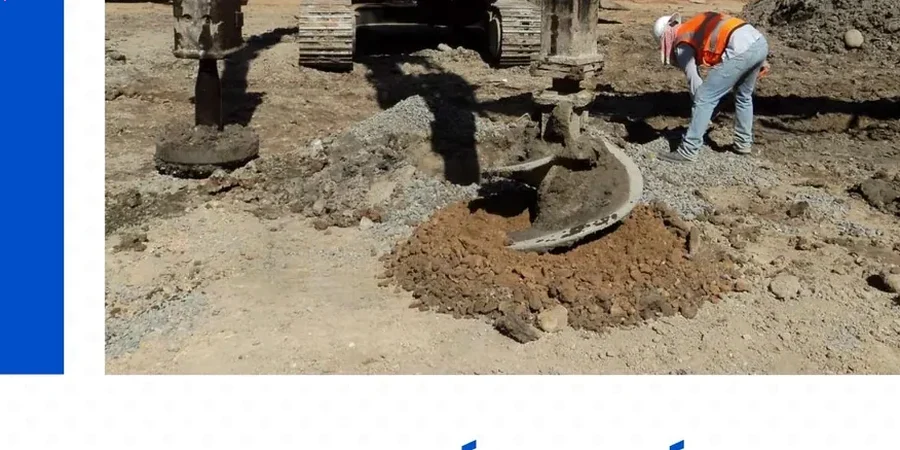
Local geotechnical conditions in Invercargill
Invercargill's growth pushed development south and west into lower-lying ground that was avoided a century ago. Those areas hold compressible estuarine silts and organic layers. A poorly designed stone column grid here creates differential settlement that cracks slabs within the first two years. The risk compounds when neighbouring structures exist. Vibro-installation generates lateral displacement and vibration. Without a pre-condition survey and vibration monitoring plan, you inherit liability for damage to adjacent footings and services. Another failure mode is inadequate depth. We regularly encounter sites where the soft layer is deeper than the borehole logs suggest. Stopping columns short of the bearing layer leaves a compressible bulb under the treatment zone. The structure then settles as a block. Our approach always includes a minimum of two CPT soundings to verify stratum thickness before finalising the column layout.
Our services
Our stone column design package covers the full cycle from site characterisation through to post-treatment verification. We work with local contractors to ensure the design is buildable with the rigs available in Southland.
Geotechnical Site Characterisation
CPT soundings, boreholes, and in-situ permeability tests to define the soft soil profile, groundwater regime, and target bearing stratum for column termination.
Column Design and Layout
Priebe-based design specifying diameter, grid spacing, depth, and stone specification. Includes settlement analysis and bearing capacity verification under static and seismic load cases.
Material Specification and Testing
Grain size analysis, LAA abrasion, and triaxial testing of proposed stone sources to confirm friction angle, stiffness, and durability for long-term performance.
Post-Installation Verification
Plate load tests on single columns and column groups, plus multi-level settlement monitoring to validate the design improvement factor and confirm performance.
Quick answers
What does stone column design cost for an Invercargill site?
Design fees for a stone column ground improvement scheme in Invercargill typically range from NZ$2,390 to NZ$7,960, depending on the treated footprint, number of columns, and required site investigation. A small residential slab on soft ground sits at the lower end; a large commercial warehouse with strict settlement tolerances moves toward the upper range.
How do stone columns perform during an earthquake in Southland?
Stone columns provide dual benefits during seismic events. The dense gravel columns resist liquefaction by dissipating excess pore pressure through drainage, and the improved composite ground reduces total and differential settlement under cyclic loading. In Invercargill's silty alluvium, the drainage function is particularly valuable because the native soil has low permeability and would otherwise trap pore pressure during shaking.
How long does it take for settlement to occur after stone column installation?
The stone columns act as vertical drains, so primary consolidation settlement typically completes within 2 to 6 weeks after installation, depending on column spacing and soil permeability. This is a major advantage in Invercargill's silty ground: without stone columns, the same settlement could take 6 to 18 months. We monitor the process with settlement plates to confirm when the rate has diminished enough to begin foundation construction.