Invercargill's development from a modest 1850s settlement into Southland's main centre has pushed construction onto some of the most challenging foundation soils in New Zealand. The city sits on deep alluvial deposits from the Oreti and Makarewa Rivers, with layers of compressible peat and soft silts that extend well below street level. When a new commercial building on Dee Street required a two-level basement adjacent to heritage-listed structures, the ground conditions demanded more than standard retaining solutions. The anchor design had to account for low shear strength in the upper 6 metres and groundwater that sits barely 2 metres below the surface across much of the central grid. Our laboratory testing confirmed that passive resistance alone would be insufficient, so we specified a combined active anchor array with deep excavation monitoring to track wall deflection during the staged dig, and recommended CPT testing to refine the bond length calculations in the silty layers.
In Invercargill's alluvial soils, anchor bond length is never a guess — it comes straight from the friction ratio your CPT and lab tests give you.
Methodology applied in Invercargill
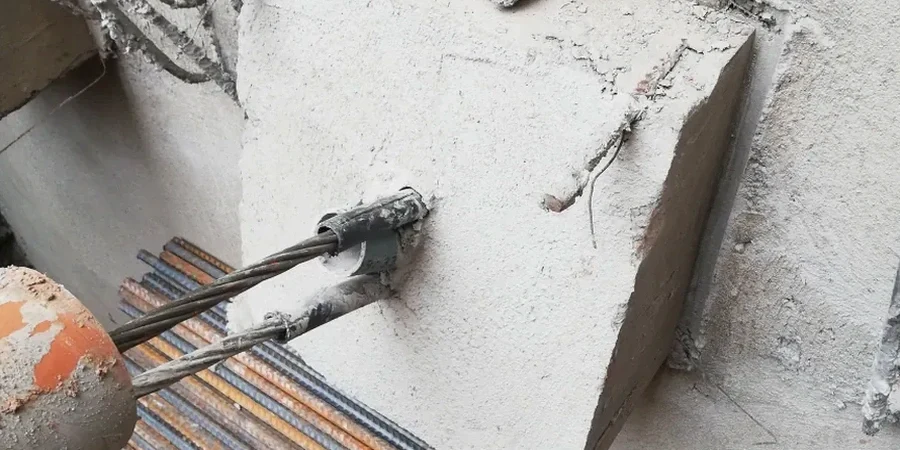
Local geotechnical conditions in Invercargill
The mistake we see repeatedly in Invercargill is contractors treating anchor design as a catalogue specification — picking a standard 15-metre anchor without verifying whether the bond zone actually sits in competent ground. When the bond length falls within the peat or soft silt layers that dominate the upper profile south of the city centre, the anchor creeps under load and the wall starts moving within weeks of tensioning. We've been called to sites where the first sign of trouble was cracking in the asphalt 3 metres behind the capping beam. Another common failure is neglecting the free length requirement through reactive clay layers — Invercargill's weather cycles mean these clays swell and shrink seasonally, and if the tendon isn't isolated through that zone, the load distribution changes unpredictably. Anchor design here must be backed by a proper geotechnical model that maps exactly where the soft-to-stiff transition occurs, otherwise you are guessing with someone else's retaining wall.
Our services
Our anchor design package for Invercargill projects includes the full chain from site investigation through to proof testing supervision.
Active anchor design
Prestressed tie-back systems for basement retention and bridge abutments. Load transfer modelled on CPT friction sleeve data from the actual bond stratum, not generic textbook values.
Passive anchor systems
Non-stressed rock bolts and soil nails for slope stabilisation in the hillier terrain north of Invercargill. Design includes corrosion protection specified for the site's groundwater chemistry.
Anchor testing and validation
Proof testing, on-site creep monitoring, and lift-off tests to verify residual load. All test records compiled to NZGS documentation standards for council sign-off.
Quick answers
What is the difference between active and passive ground anchors?
Active anchors are prestressed — we apply a lock-off load to the tendon immediately after grouting reaches strength, which actively compresses the ground and controls movement from day one. They are typical where you cannot tolerate lateral displacement, like in front of an existing building. Passive anchors are not tensioned; they only develop resistance when the ground starts to move and the anchor stretches. In Invercargill we often use active anchors near the top of a retention system and passive elements deeper down where some controlled movement is acceptable.
How deep do anchors need to go in Invercargill's alluvial soils?
It depends entirely on where the competent bearing stratum sits. In central Invercargill the soft silts and peats can extend to 6 or 7 metres below ground level. The bond zone must be in dense gravels or stiff clays below that. We determine the exact depth using CPT cone resistance profiles — friction ratios above 2% in the gravels typically give us the grout-to-ground bond values we need to size the fixed length.
What does anchor design and testing cost for a typical Invercargill excavation?
For a small to medium retaining wall project in Invercargill, the anchor design package including site investigation interpretation, bond length calculations, tendon specification, and on-site proof testing supervision generally ranges from NZ$1,840 to NZ$6,090 depending on the number of anchor rows, the complexity of the ground profile, and the testing duration required by the consent conditions.
Which standards apply to anchor corrosion protection in New Zealand?
The NZGS Anchor Guidelines set out the corrosion protection requirements based on anchor service life. For permanent anchors (design life over 2 years), double barrier protection is mandatory — typically a corrugated HDPE duct filled with cement grout, with the tendon inside. For temporary anchors used during construction only, single barrier protection may be acceptable. We also reference NZS 3404 for the steel components and AS/NZS 4671 for bar and strand material specifications.
How do you verify that an anchor is performing correctly after installation?
Every anchor undergoes either a proof test or a suitability test depending on whether it's a production or trial anchor. We apply a load of 150% of the working load in increments, holding at each step to measure creep. The acceptance criteria in the NZGS guidelines specify maximum creep rates — typically less than 2 mm per log cycle of time during the hold period. After lock-off, we sometimes perform lift-off tests weeks later to confirm the residual load hasn't dropped due to ground relaxation or tendon slip.