The alluvial gravels underlying north Invercargill near Waikiwi bear little resemblance to the deeper, compressible silts you encounter out towards the Awarua Plain. Driving a few kilometres can shift your seismic site response from a firm Class C to a softer Class D, a difference that fundamentally alters your foundation design. In our experience running ground investigations across the Southland region, developers who treat the city as a uniform block often face costly redesigns once dynamic analysis contradicts their initial assumptions. A properly executed seismic microzonation bridges this gap by mapping how the basin-edge effect and varying depth to the Quaternary basement influence ground motion amplification, giving you a block-by-block picture rather than a broad-brush guess. Southland's deep Pleistocene deposits, shaped by glacial outwash and marine regression, create localised impedance contrasts that standard borehole logs alone cannot capture. We integrate MASW profiles and CPT soundings to populate a site response model that aligns with the NZGS guidelines and the performance-based framework of NZS 3404, ensuring your structural engineer works with data that reflects the actual subsurface geometry beneath Invercargill.
In Invercargill, the distance from the Oreti River can shift your site class from C to D within 300 metres — a detail that changes your entire seismic design spectrum.
Methodology applied in Invercargill
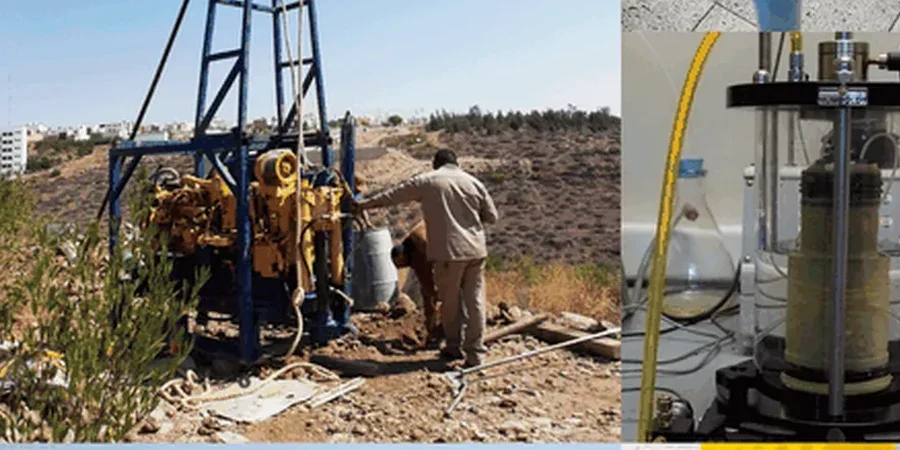
Local geotechnical conditions in Invercargill
NZS 3404 and the NZGS seismic classification guidelines set a clear expectation: site-specific ground motion assessment is required where soil depth exceeds 30 metres or where lateral variability is significant. This describes nearly the entire Invercargill urban area, where the Tertiary-Quaternary sediment pile can reach well over 100 metres thick. Ignoring this requirement leaves a project structurally noncompliant and exposes the design engineer to professional liability if ground motion is underestimated. The basin-edge geometry near the Bluff fault system introduces the added hazard of basin-generated surface waves that extend shaking duration beyond what a simple attenuation model predicts. In our work across the city, we have measured fundamental periods exceeding 0.6 seconds on deep silt profiles, which can coincide with the natural period of mid-rise structures and amplify drift demands. A thorough seismic microzonation for Invercargill sites is not a paperwork exercise — it is the difference between a building that survives the 2500-year event and one that undergoes unplanned inelastic deformation because the soil response was never properly quantified.
Our services
We approach seismic microzonation in Invercargill as a three-stream investigation that links geology, geophysics, and geotechnics. Each component below feeds into a unified site response model.
Basin-Scale Microzonation Mapping
For large industrial sites or subdivision developments across Invercargill, we produce grid-based maps of Vs30, site period, and spectral amplification factors using a combination of microtremor array measurements and active-source MASW. These maps allow you to position critical infrastructure on the most competent ground patches while still complying with Southland District Council consent conditions.
Site-Specific Response Spectra Development
We generate code-compatible design spectra from measured shear wave velocity profiles rather than generic soil factors. Using 1D equivalent-linear analysis or 2D basin models where the lateral contrast is sharp, we deliver PGA and spectral ordinates at multiple return periods that your structural engineer can plug directly into the NZS 3404 performance-based design framework.
Liquefaction Susceptibility Integration
Microzonation gains practical value when it is paired with a liquefaction susceptibility assessment. Where our Vs30 mapping identifies loose saturated sands within the upper 15 metres, we overlay CPT-based liquefaction triggering curves to flag zones where ground improvement or deep foundations become mandatory, saving you from discovering this after excavation begins.
Quick answers
How is a seismic microzonation different from a standard site investigation in Invercargill?
A standard site investigation focuses on bearing capacity and settlement for static loads. A seismic microzonation measures dynamic soil properties — shear wave velocity, fundamental site period, and ground motion amplification — that control how the soil column will shake during an earthquake. In a city with Invercargill's deep Quaternary sediments, the two sets of data address fundamentally different risks and should be treated as complementary rather than interchangeable.
Does Invercargill really need site-specific seismic studies given it is far from the Alpine Fault?
Distance from the plate boundary does not eliminate seismic hazard. Invercargill sits within a region of distributed faulting, including the Bluff and Hillfoot fault systems, and the deep sedimentary basin can amplify long-period ground motion from distant large-magnitude events. The NZGS guidelines specifically call for site-specific assessment where soil depth exceeds 30 metres, which applies to much of the city.
What is the typical cost range for a seismic microzonation study in Invercargill?
For a site-specific study covering one or two building pads, costs typically range from NZ$6,720 to NZ$25,000 depending on the number of geophysical lines, borehole tie-points, and the complexity of the basin model required. A broader microzonation covering a subdivision or industrial park will fall toward the upper end of that range due to the spatial coverage needed.
Can you use existing borehole logs to build the seismic model?
Existing borehole logs provide useful stratigraphic control, but they rarely include shear wave velocity measurements, which are the essential input for site response analysis. We typically overlay new geophysical lines — usually MASW or downhole seismic — onto the existing borehole grid so that the velocity model is calibrated to known geology, avoiding the uncertainty that comes from inferring dynamic properties from SPT blow counts alone.