Invercargill’s seismic profile is often underestimated simply because the city sits at the southern end of the Alpine Fault’s stress shadow. That perception shifts abruptly when you overlay the local geology—thick alluvial gravels from the Oreti River, interspersed with soft estuarine silts near the New River Estuary, all resting above the Murihiku Terrane basement. These layered deposits, combined with a shallow water table across much of the urban grid, create a site-response environment where ground motions can amplify in ways that conventional fixed-base design misses. For critical facilities, industrial plants, and multi-storey buildings, we apply base isolation seismic design that decouples the superstructure from ground motion, using lead-rubber or friction pendulum bearings tailored to Invercargill’s spectral acceleration profile. Every isolation system we specify begins with a full geotechnical characterisation, often requiring CPT testing to map the impedance contrast between the gravel cap and the underlying compressible layers.
Decoupling a structure from Invercargill’s soft alluvial soils demands more than bearing selection—it requires a complete understanding of site response across the soil column.
Methodology applied in Invercargill
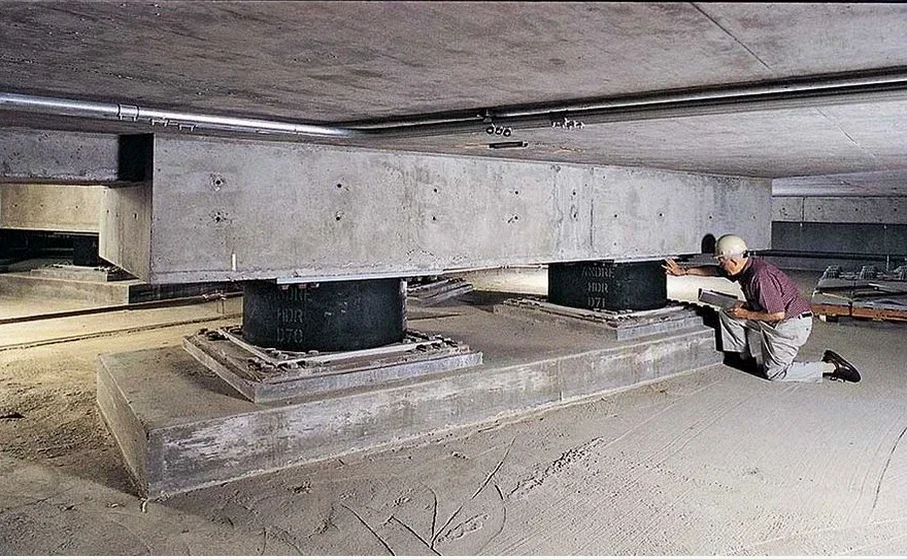
Local geotechnical conditions in Invercargill
The most persistent mistake we see in Invercargill is a consultant specifying isolation bearings using the Z-factor for Christchurch or Wellington and assuming the same displacement demand applies down south. The spectral shape in Southland is different—the hazard is dominated by deeper, moderate-magnitude events that produce longer-period content, which means the displacement demand on a Class D site in Invercargill can exceed 350 mm under MCE even when peak ground acceleration appears modest. A second common error is ignoring the effects of the shallow water table on bearing pad stability. When the moat wall or the isolation plane sits within two metres of the groundwater surface, buoyancy effects and pore pressure migration during shaking alter the vertical load path, and bearings can experience unplanned tensile excursions if the soil-structure interaction is not modelled. Our team runs time-history analyses with site-specific ground motions, not generic code spectra, to capture the real displacement envelope for Invercargill conditions.
Our services
Our base isolation design service in Invercargill covers the full project lifecycle, from feasibility screening through detailed design to construction-phase testing. We work closely with structural engineers to ensure the isolation interface is integrated into the lateral force-resisting system without conflicts at the moat or utility crossings.
Isolation system design and peer review
We prepare bearing schedules, displacement budgets, and moat wall detailing for Invercargill projects, including non-linear time-history analysis calibrated to site-specific ground motions. All designs are documented to NZS 4203 and NZS 1170.5 requirements.
Prototype bearing testing oversight
We specify the testing protocol per ISO 22762 and witness full-scale bearing tests at the manufacturer’s facility, verifying that the hysteretic behaviour matches the design loops before the bearings ship to Invercargill.
Quick answers
How does base isolation differ from a standard fixed-base seismic design?
A fixed-base structure dissipates energy through ductile yielding of beams, braces, or walls, which means damage is part of the design strategy. Base isolation introduces a flexible layer at the foundation level that shifts the building’s fundamental period well beyond the dominant earthquake energy, typically past 2.0 seconds on Invercargill soils. The superstructure above the isolation plane moves almost as a rigid body, so inter-storey drifts drop dramatically and non-structural damage is minimised. The trade-off is that the isolation bearings must accommodate large horizontal displacements—often 300 mm to 450 mm under MCE on Class D sites in Southland—which requires careful moat detailing and flexible utility connections.
What is the typical cost range for base isolation seismic design in Invercargill?
For a complete isolation design package covering bearing selection, non-linear analysis, and construction documentation, the professional fee in Invercargill typically ranges from NZ$6,260 to NZ$14,730 depending on the building footprint, number of storeys, and the complexity of the geotechnical site model. This does not include the bearing hardware cost, which is quoted separately by the manufacturer.
Which types of buildings in Invercargill benefit most from base isolation?
The strongest business case for isolation in Invercargill applies to facilities where post-earthquake functionality is essential: the hospital, data centres, emergency operations centres, and industrial plants with sensitive equipment. Museums and heritage buildings also benefit because isolation protects brittle unreinforced masonry elements that would otherwise require extensive strengthening. For residential construction, the economics are harder to justify unless the site sits on Class D soils with proven amplification, where the reduction in structural damage can offset the bearing investment over the building's service life.
Is base isolation feasible on sites with high groundwater?
Yes, but it adds complexity. Invercargill has extensive areas where the water table sits within 1.5 m of the surface, particularly near the estuary and the Oreti River floodplain. We design the isolation pit with a drained moat configuration, install waterproofing membranes below the isolation plane, and specify bearing pads that are fully submerged-rated. The buoyancy force on the structure must be included in the vertical load budget, and the drainage system must remain functional after the design earthquake. We typically require a CPT-based stratigraphic log to confirm the seasonal high-water mark before finalising the moat depth.
How do you verify that the isolation system will perform as designed?
Verification happens in three stages. First, we run a suite of non-linear time-history analyses using at least seven ground-motion records that match the Invercargill site’s spectral shape and duration. Second, every bearing undergoes factory production testing at full scale, where we confirm the effective stiffness, yield force, and hysteretic damping at the design displacement. Third, during construction we specify in-situ bearing acceptance tests on a sample of installed units before the superstructure is released onto the isolation plane. The whole process follows the testing hierarchy defined in ISO 22762 for elastomeric seismic-protection isolators.