Any earthworks contractor in Invercargill knows the ground can be unpredictable. One corner of the site is firm, the next is saturated peat. NZS 3404 and the NZGS guidelines don’t leave room for guesswork—compaction control has to be measured, not assumed. The sand cone method remains the most straightforward way to verify that fill density meets spec, and it travels well to tight urban backlots in Gladstone or big infrastructure sites out toward Bluff. Invercargill’s shallow water table and underlying Quaternary alluvium mean lift compliance can fail fast if the testing schedule is loose. We bring the calibrated sand, the cone apparatus, and a direct reporting format that lets you sign off layers without waiting on lab turnaround. For deeper ground profiling before fill placement, we often pair this with a CPT test to map any hidden soft zones that would compromise long-term settlement performance.
A single failed density test on a lift buried under three more layers costs ten times the original field check to remediate.
Methodology applied in Invercargill
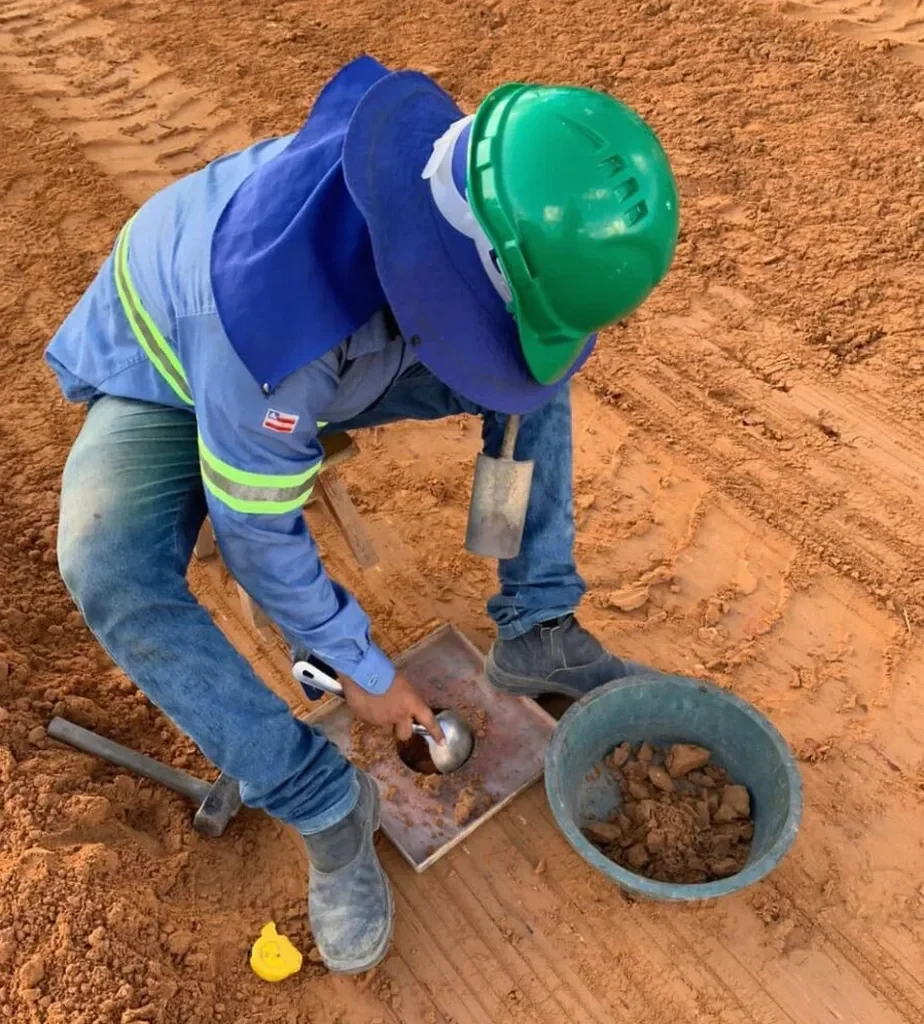
Local geotechnical conditions in Invercargill
The risk profile changes completely between the Windsor side of the city and the Queens Park area. Windsor sits on older alluvial terraces where the gravels compact predictably and density failures are usually about inadequate roller coverage, not the soil itself. Queens Park and the streets around it are closer to the original estuarine basin—organic silts, peat lenses, and groundwater at less than a metre. There, a passing density test on a sunny Tuesday can fail on a rainy Thursday because the subgrade swells and the surface compaction shears off. The sand cone test catches this because it measures what’s actually in the ground, not what was there yesterday. Skipping a retest after weather events or rushing ahead without proof-rolling the subgrade can embed a soft layer that causes differential settlement within the first two years. Invercargill’s frequent drizzle isn’t an excuse—it’s the condition you design the testing programme around.
Our services
Our field density service in Invercargill is built around fast deployment and clear QA documentation. Each test point includes calibrated sand cone measurement, moisture determination, and a short interpretive note so the foreman knows whether to green-light the next lift.
Compaction Verification (Sand Cone)
Direct density measurement for fill lifts, trench backfill, and pavement subgrades. Results referenced against laboratory Proctor curves.
Moisture Content Determination
Oven-dry moisture on every density point. Critical in Invercargill where elevated moisture is the primary cause of compaction failure.
QA Documentation Packages
Site plans with test locations, density results, pass/fail summaries, and corrective action notes formatted for council or NZTA submission.
Pre-Compaction Ground Assessment
Rapid assessment of subgrade condition before fill placement begins—identifies soft zones that would guarantee future density failures.
Quick answers
How much does a sand cone density test cost in Invercargill?
A single field density test using the sand cone method typically costs between NZ$170 and NZ$270 per point, depending on site access, number of points in a day, and whether moisture content is included. We can provide a firm quote once we know the lift area and testing frequency.
How long does a density test take on site?
The field portion takes about 15–20 minutes per point once the surface is trimmed. The limiting factor is usually access across the fill layer—moving between points on a large pad takes longer than the test itself. Results are available immediately for the density value; the moisture content figure follows once the sample has been oven-dried, typically within 24 hours.
What compaction standard do I need for a residential subdivision in Southland?
Most residential subdivisions in Invercargill are consented under NZS 3404, which requires 95% relative compaction for general fill and 98% for the top 300 mm of subgrade. The exact specification will be in your approved consent documents—we can work from whatever standard the engineer has nominated.
Can you test through gravel or cobble fills?
The sand cone method works well up to a maximum particle size of about 50 mm. If the fill contains larger cobbles, the NZGS guidelines recommend an oversize correction or switching to a water replacement method for the affected test points. We’ll advise on the right approach after seeing the fill material.