Invercargill sits on deep Quaternary alluvium, with groundwater often just half a metre below the surface in winter. The 2010 Darfield earthquake sequence, though centred further north, prompted a region-wide review of retaining structures on soft soils, and here in Southland that meant reassessing how we design for liquefaction-prone silts and peats underlying many suburban subdivisions. When a new build in Windsor or a commercial extension in the CBD needs a retaining wall, the design cannot simply be copied from an Auckland volcanic site; it has to start from the ground up, literally. We routinely combine a retaining wall design scope with a CPT test to map the undrained shear strength of the Oreti River deposits, because cone data gives us the continuous profile that SPT alone misses in these interbedded layers. The council expects compliance with NZS 3404 and the NZGS Retaining Wall Guidelines, and our reports are structured to meet that consenting pathway without costly back-and-forth.
A well-designed retaining wall in Invercargill is as much about managing water as it is about resisting earth pressure.
Methodology applied in Invercargill
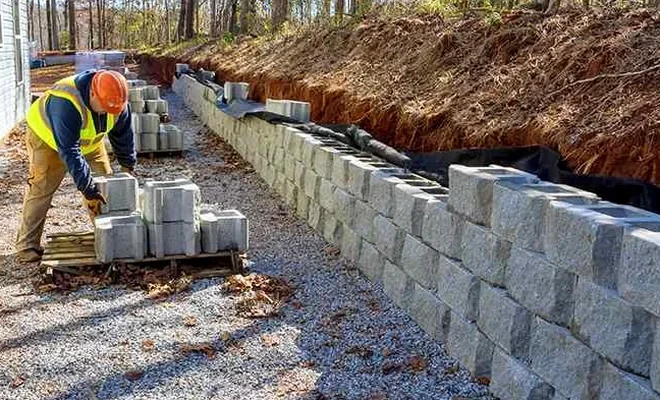
Local geotechnical conditions in Invercargill
The biggest contrast in Invercargill’s ground is between the firm gravel ridges near the estuary and the soft, compressible floodplain soils that stretch across most of the city’s residential land. A retaining wall that performs perfectly on the gravel may tilt or settle excessively just two streets away on the silt, because the foundation modulus can drop by an order of magnitude. Add the region’s 1,100 mm of annual rainfall and the near-constant moisture flux in the top metre, and you have conditions that punish any oversight in drainage design. The NZGS Retaining Wall Guidelines explicitly require both short-term and long-term stability checks, and we extend that to a sensitivity analysis on the phreatic surface, because a blocked subsoil drain in August can raise pore pressures behind the stem faster than most designers assume. Where the wall retains a public right-of-way, we also coordinate with the Invercargill City Council’s infrastructure team to ensure the design accounts for any future road widening or service trenching that could undermine the heel.
Our services
Every retaining wall project in Invercargill starts with a clear understanding of the ground profile, and we structure our technical support around three core phases: investigation, analysis, and design documentation.
Site investigation and material characterisation
We specify and supervise CPT soundings, test pits, and laboratory testing to build a ground model that captures the layering, strength, and drainage properties of the Southland alluvium before a single design parameter is fixed.
Stability and structural design
Using limit equilibrium and numerical methods, we produce designs for gravity, cantilever, and anchored walls that satisfy NZGS and council consenting requirements, with clear documentation of all load cases including seismic and groundwater extremes.
Construction-phase review and drainage verification
We review subgrade conditions during excavation, confirm that the ground matches the design assumptions, and inspect drainage installations to reduce the risk of post-construction water pressure buildup behind the wall.
Quick answers
What does a retaining wall design typically cost for a residential site in Invercargill?
For a straightforward residential retaining wall in Invercargill, the design fee ranges between NZ$1,890 and NZ$7,250 depending on the height, complexity, and whether additional investigation like a CPT is needed. Taller walls, anchored systems, or sites with peat layers will fall toward the upper end of that range.
Do I need a geotechnical investigation before a retaining wall is designed in Invercargill?
Yes. The Invercargill City Council will normally require a site-specific geotechnical report for any wall over 1.5 metres in height, and the NZGS Retaining Wall Guidelines make investigation mandatory for all engineered walls. Without it, the design assumptions are speculative and consent will likely be delayed.
What type of retaining wall works best on the soft soils common in Southland?
There is no single answer, but we often find that a reinforced concrete cantilever wall with a well-designed drainage blanket performs well on the alluvial silts and gravels of Invercargill, provided the foundation is taken below any organic or highly compressible layers. Where the soft layer is too deep, a piled wall or a mechanically stabilised earth structure may be more appropriate.
How do you account for earthquake loads in a retaining wall design in Invercargill?
We apply the seismic provisions of NZS 4203 and the NZGS guidelines, using a seismic hazard factor Z of 0.13 for Invercargill. The design includes a pseudo-static analysis with a horizontal acceleration coefficient, and for higher walls or sensitive sites we run a Newmark-type displacement check to ensure the wall can tolerate the expected movement without serviceability failure.
How long does it take to produce a retaining wall design for a consent application?
Once the ground investigation data is available, a typical residential retaining wall design can be completed within two to three weeks. More complex walls requiring iterative analysis or peer review may take four to five weeks, and we always coordinate the timeline with the client’s consent lodgement programme.