A four-storey commercial building on Dee Street required a site subsoil class before the structural engineer could finalize the lateral design. The site sits on the deep alluvial gravels and silts of the Mataura catchment, and borehole refusal was shallow. We deployed a 48-channel MASW array across the footprint. In 90 minutes we had a VS30 of 210 m/s, placing the site firmly in Class C. Invercargill’s flat topography masks a complex Quaternary sediment stack — the Oreti and Makarewa river systems laid down interbedded lenses that create velocity inversions. A borehole alone misses these. The MASW method maps them directly. For near-surface materials where CPT refusal is common, the surface-wave approach becomes the primary seismic tool. We often pair it with seismic refraction when bedrock depth is also needed for foundation design in the city’s older industrial precincts.
VS30 is not a number you look up in a table — it is measured on your actual site, with your actual stratigraphy, under your actual groundwater conditions.
Methodology applied in Invercargill
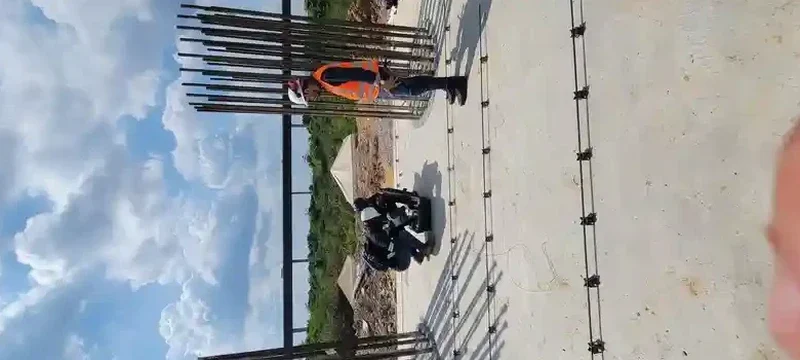
Local geotechnical conditions in Invercargill
The field setup for a MASW survey in Invercargill uses a linear spread of 24 or 48 vertical geophones coupled to the ground with spikes pressed into grass or asphalt. The sledgehammer strike is stacked five to eight times at each offset. The most common issue we see on the Southland Plains is wind noise — a steady westerly across the open paddocks generates low-frequency ground roll that contaminates the dispersion image below 8 Hz. We run surveys in early-morning calm windows and use spectral filtering during processing. Another risk is saturation of near-surface silts after heavy rain, which attenuates high-frequency energy and truncates the dispersion curve above 30 Hz. We adapt the source offset and increase stack count in these conditions. Skipping these adjustments yields an unreliable VS30 and a site class that may be off by a full category — the difference between Class C and Class D carries significant implications for base shear demand.
Our services
Our Invercargill MASW surveys are delivered as part of a broader site investigation package. The three services below represent the most common combinations we provide for projects on the alluvial soils of the Southland region.
VS30 Site Classification
Single-array MASW survey with fundamental-mode inversion. Delivers a VS30 value and NZS 3404 site class for building consent documentation in Invercargill City Council jurisdiction.
2D Shear Wave Velocity Cross-Section
Multiple overlapping MASW arrays along a profile line. Produces a continuous shear wave velocity section for assessing lateral variability across larger footprints such as warehouse platforms or school sites.
Combined MASW and Seismic Refraction
Paired surface-wave and refraction survey on the same spread. Provides both VS30 and depth to bedrock, useful where the Mataura gravels thin against the Bluff norite basement toward the south of the city.
Quick answers
What does a MASW survey cost for a residential site in Invercargill?
For a standard residential section requiring a single VS30 measurement, the survey typically ranges from NZ$3,210 to NZ$5,100 depending on array length, access conditions, and whether a written report with NZS 3404 site classification is required for building consent.
How long does a MASW survey take on site?
A single-array MASW acquisition on a clear Invercargill section takes about 60 to 90 minutes including setup, calibration, and multiple source offsets. Sites with limited access or high wind noise may extend fieldwork to two hours.
Can MASW work on the soft peat soils found around Invercargill?
Yes, and it works well. The low shear wave velocity of peat produces a strong fundamental-mode dispersion curve. The key is using a shorter array spacing and a lighter source to capture the low-velocity near-surface signal without saturating the geophones.
What depth does the VS30 calculation actually sample?
VS30 is the time-averaged shear wave velocity in the upper 30 metres. The MASW array must sample to at least that depth, which in Invercargill typically requires a 70 to 96 m spread length depending on the site’s stiffness. The calculation follows the NZGS Module 3 procedure.