Invercargill’s ground tells a story shaped by the Oreti River’s floodplain and layers of soft peat that sit just beneath the city. A soil mechanics study here demands more than textbook equations—it requires interpreting how these saturated silts and organic soils behave under load. The average annual rainfall of roughly 1,100 mm keeps the water table high across Southland, which directly influences effective stress and consolidation rates. For any structural design in the city, from residential footings to commercial slabs, understanding the shear strength and compressibility of these local deposits is the difference between a foundation that performs and one that develops unexpected settlement. Before finalising a design, many engineers pair our analysis with a CPT test to obtain continuous stratigraphic profiles without disturbing the sensitive peat structure.
Effective stress parameters from triaxial testing on Southland silts often reveal undrained shear strengths below 30 kPa—values that demand careful foundation design.
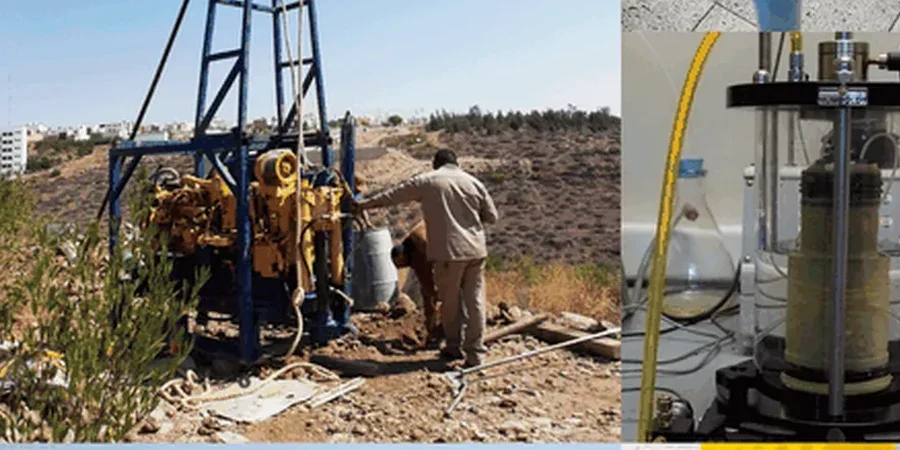
Methodology applied in Invercargill
Our laboratory testing program applies NZS 4402 methods to determine particle size distribution and the Atterberg limits, which are essential for classifying the highly plastic clays found in pockets across the city’s industrial zones. The triaxial apparatus, capable of consolidated-undrained testing with pore pressure measurement, delivers the effective stress parameters that feed directly into finite element models. We focus on generating data sets that account for the natural variability of the alluvial deposits rather than assuming a homogeneous mass, because in Invercargill, a borehole on one side of Tay Street rarely matches the profile 50 metres away.
Local geotechnical conditions in Invercargill
The peat lenses underlying parts of Invercargill, especially toward the estuary margins, present a consolidation risk that cannot be ignored. These organic soils have a high void ratio and compressibility index, meaning they undergo significant volume reduction over time as pore water drains under structural loading. Differential settlement becomes a real concern when a footing spans from a firm gravel lens into a soft peat pocket.
Secondary compression in the peat continues long after primary consolidation ends, and this creep behaviour can distort slabs and utility connections over a decade. The NZGS guidelines for peat engineering recommend sampling with thin-walled tubes to minimise disturbance, because remoulded peat gives strength values that are dangerously optimistic. Without a site-specific soil mechanics study, the long-term serviceability of a building in Invercargill remains an open question.
Our services
We structure each soil mechanics study in Invercargill around the specific geotechnical challenges of the site, delivering parameters that structural engineers can apply directly in their models.
Triaxial Compression Testing
Consolidated-undrained and drained triaxial tests on undisturbed Southland silts to define the Mohr-Coulomb failure envelope under in-situ stress conditions.
Oedometer Consolidation Analysis
Incremental loading oedometer tests to determine compression index, recompression index, and coefficient of consolidation for the city’s compressible peat layers.
Direct Shear on Granular Soils
Slow drained direct shear on the Oreti River sands to establish peak and residual friction angles for bearing capacity and retaining wall design.
Classification and Index Testing
Full NZS 4402 suite covering Atterberg limits, linear shrinkage, and hydrometer analysis to correctly classify the variable Invercargill alluvium.
Quick answers
What parameters does a soil mechanics study provide for Invercargill’s peaty ground?
We determine the effective shear strength parameters (c’ and φ’), undrained shear strength, compression index, and coefficient of consolidation. For peat specifically, we also measure organic content and secondary compression characteristics so engineers can calculate both primary and creep settlement.
Is triaxial testing necessary for a residential foundation in Invercargill?
For single-storey residential slabs on competent gravel, index testing may suffice. However, if the site investigation reveals soft peat or silty clay layers within the influence zone of the footings, a consolidated-undrained triaxial test gives the accurate effective stress parameters needed to avoid under-designing the foundation.
How much does a soil mechanics study cost in Invercargill?
A targeted study with classification tests and a triaxial suite generally runs between NZ$5,420 and NZ$9,240, depending on the number of specimens, the complexity of the peat profile, and whether consolidation testing is required.
Which NZ standards govern the laboratory testing for soil mechanics in New Zealand?
The primary standard is NZS 4402, which covers everything from moisture content and Atterberg limits through to triaxial compression. We also reference NZGS guidelines for peat sampling and testing, and the site subsoil classification follows NZS 1170.5 for seismic applications.
How do you obtain undisturbed samples of Invercargill’s soft peat?
We use thin-walled Shelby tubes or piston samplers advanced with minimal vibration into the peat layer. The tubes are sealed immediately to preserve the natural water content. Standard split-spoon sampling remoulds the peat and yields unrealistically low strength values, so we avoid it for any consolidation or triaxial work.